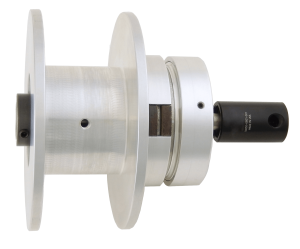
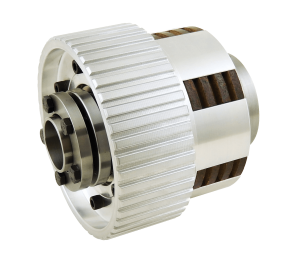
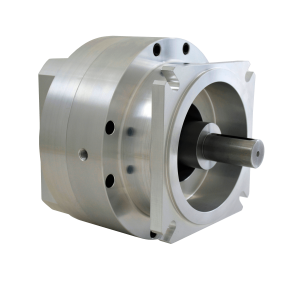
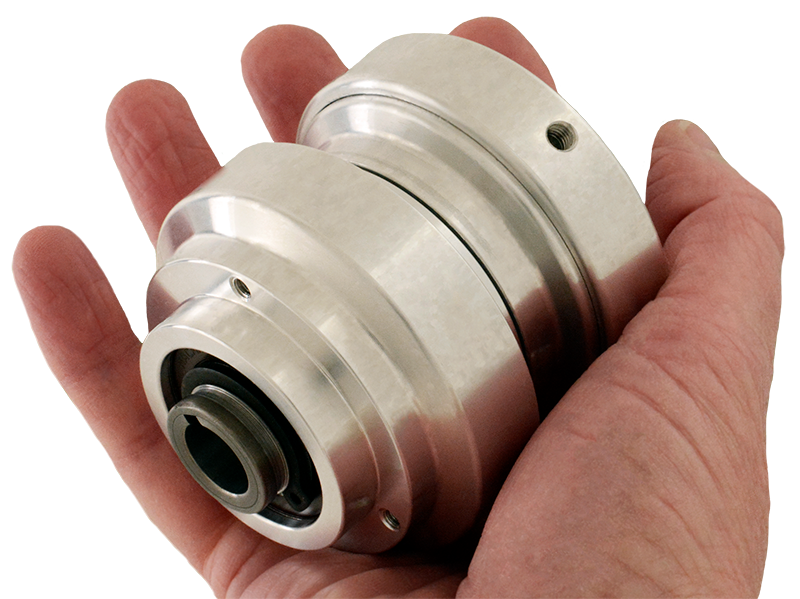
In addition to producing all of the drive hubs, housings, pistons, nuts, adapters, etc. for Mach III designed products, our CNC department does job shop work to the same exacting standards we hold for our own components. We have experience machining . . .
- aluminum
- alloy steels
- stainless steels
- ductile and gray irons
- copper & bronze
Parts can be made in diameters to 15.75 inches. Send your parts drawings to info@machiii.com to obtain a quote for material and machining.
Spring engaged clutch and spring engaged brake designs are only indicated for applications requiring the clutch or brake to remain engaged when the air supply is removed or fails. A fail safe holding brake would be one example. Another example can be seen on our Applications page where a spring set brake was used on an Universal Studios attraction. Additional links: spring set flange mount brakes, spring set NEMA frame brakes, end of shaft mount spring set clutches - regular duty and heavy duty. Air engaged clutches and brakes are more suitable for cycling applications. If there is any question which is best for your application, contact Mach III’s engineering department for a quick answer.
The ball bearing pilot clutch is generally recommended. Mach III has a variety of ball bearing pilot clutches to choose from: regular duty end of shaft mount, regular duty through shaft mount, heavy duty end of shaft mount and heavy duty through shaft mount. Bronze bushing pilot clutches are only appropriate in cases where the speed of the clutch is under 200 RPM and the sprocket or pulley that must be mounted on the pilot is too small for the ball bearing pilot version. Mach III offers bronze bushing pilot clutches in both end of shaft mount and through shaft mount styles.
Whether using a bronze bushing or ball bearing pilot clutch, properly attaching the pulley or sprocket to the pilot is important if the clutch is to function and wear correctly. Click here to view Mach III’s eBook on this topic.
The air required to engage (in air engaged/spring released units) or disengage (in spring engaged/air released units) a clutch, brake, combination clutch-brake is the volume to fill the area between the cylinder and piston. Air is not consumed until it is exhausted from the unit. Air volumes are listed on the downloadable PDF detail sheets available for each catalog product on this website (click here for example). Air volumes of non-catalog products can be obtained by contacting engineering.
The most important thing know is that you do not have to do this yourself. Mach III will ship the sprocket or pulley you require pre-mounted on the pilot of the clutch, clutch-brake or torque limiter you’ve ordered. If this is a replacement or new addition to a Mach III unit you already have, we can supply the sprocket or pulley pre-bored and tapped to fit the pilot. Contact customer service for pricing and information.
For those who prefer to machine their own sprockets and pulleys:
Use the following formula to determine the torque rating at an alternate psi value:
Torque = (Design Torque x 25 psi) / 80 psi
Every catalog product ordered is manufactured with the bore size specified by our customer. The bore sizes shown for Mach III catalog products are MAXIMUM bores size available for that product with a standard keyway. Mach III also supplies METRIC bores and keyways and can supply non-standard keyways.
If you have a non-catalog unit, the bore and keyway sizes are typically specific sizes associated with the special part number assigned to that product. Contact engineering if you need to order a non-catalog product with a different bore or keyway size than you have currently.
Wear in is a function of speed, load and cycles. In most cases a few dozen cycles will achieve the desired burnishing.
Mach III thru shaft clutches and all combination clutch/brakes require installation of an anti-rotation arm to prevent rotation of the cylinder. The attached file contains installation recommendations.
Anti-Rotation Arm Mounting Instructions.pdf (99.79 kb)
Contact customer service with the product number of the unit. They can supply parts lists, installation and maintenance documents, parts and kit numbers and pricing. For a guide to locating the Mach III product number see the Identifying a Product page under the RESOURCES menu.